16 and Pregnant Shoots Baby Father Holding Bible
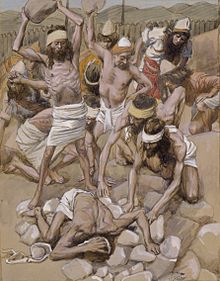
Death sentence in the Bible refers to instances in the Bible where death is called for as a punishment and too instances where it is proscribed or prohibited. Perchance the strongest case against death penalty in the New Testament tin be made from John 8, where Jesus seems to say that it should not be carried out contrary to Mosaic law. In that location are however far more verses that command and condone death penalty, and examples of it being carried out, especially in the Torah/Old Testament. Sins that were punishable past death include: homicide, hitting ane's parents, kidnapping, blasphemous one'southward parents, witchcraft and divination, bestiality, worshiping other gods, violating the Sabbath, kid sacrifice, adultery, incest, and male homosexual intercourse (there is no biblical legal penalisation for lesbians).[one]
Against capital punishment [edit]
While the Bible very clearly condones and commands capital penalization, there are verses that can be interpreted as opposing the exercise. For case, when Cain murdered Abel, God sentenced him to wandering as a fugitive rather than to death, and even issued a warning against killing Cain. A similar sentiment is suggested in Proverbs 28:17. It is seen from two Samuel fourteen:1-11 that kings would grant clemency in extenuating circumstances. In that case, the one who had killed was an but kid, and the king allowed him to remain alive under house arrest. The prophets repeatedly beseech the masses to repent so that God volition not destroy them. Additionally, there are numerous verses that condemn revenge, judging, anger and hatred, as well equally those that promote peace harmony, forgiveness and acceptance.[2] [three]
Hiers (2004 & 2009) shows that the laws related to capital penalization shifted over time with old laws being abandoned, and new laws taking their place; even so, he points out that some afterward laws seem to mitigate the severity of before ones. He further quotes Glen Stassen who argues that fifty-fifty in biblical times, capital punishment was "gradually, if not progressively" beingness abandoned, pointing out that death penalty is rarely found in the Prophets and the Writings. Paul Onyango cites Carol Meyers argues that treatment of adulteresses in Ezekiel sixteen and 23 is far more than progressive than that of other aboriginal almost eastern cultures of the time, due to its abstention/rejection of death sentence.[iv]
Possibly the strongest instance against death sentence can be made from John eight, where Jesus seems to say that death sentence should not be carried out contrary to Mosaic law. In John eight, the Pharisees challenge Jesus by presenting a woman who they say committed infidelity. They point out that the law of Moses conspicuously states that such a woman ought exist stoned, and claiming Jesus to give his opinion every bit to what should be done. Jesus famously states "let he who is without sin throw the beginning rock." Effectively maxim that majuscule penalization should not exist carried out, without straight contradicting the law of Moses.[2] [3]
While these examples may prove that there was at least some opposition to death sentence and pass up in usage, there can be no uncertainty that there are far more than numerous verses that command and condone capital punishment, and examples of it being carried out.[2] [3]
Torah/Old Testament [edit]
Capital letter sins [edit]
The Bible states that for the expiry penalty to be carried out, at least two witnesses were required.[5] (According to Rabbinic tradition, there were numerous other conditions/requirements (such as a warning) that made it difficult to go a confidence.)
Sins that were punishable past death in the Torah, included the following:[2] [3]
Homicide (excluding negligent homicide),[6] to strike/assail/smite ane's parents,[7] kidnapping[eight] cursing i's parents,[9] witchcraft and divination,[10] [11] bestiality[12] worshiping other gods,[thirteen] violating the Sabbath[14] kid sacrifice,[15] adultery,[sixteen] incest,[17] and male person homosexual intercourse (there is no biblical legal punishment for lesbians).[18] [19] The daughter of a Kohen who defiles herself through harlotry,[20] blaspheme (of the Tetragrammaton name of God),[21] a not-Levite "encroaching" on the Levite job of setting up or taking down the Tabernacle,[22] a not-Kohen carrying out priestly duties,[23] promoting the worship of other gods (if an entire boondocks is swayed by such people, the entire town is to exist put to decease and destroyed),[24] defiantly refusing to accept a court's ruling,[25] maliciously giving false testimony accusing another person of having committed a majuscule offence,[26] rebellion against parents,[27] If a man marries a girl and claims that she is not a virgin, the girl's parents should produce evidence of her virginity. If it is found that she was not a virgin, she is stoned to death for fornicating while still under her father's authority,[28] intercourse with an engaged/matrimonial virgin daughter (if she could accept cried out for help and did not, she is killed as well).[29] [2] [3]
Methods [edit]
The well-nigh common method mentioned is by stoning, followed past burning, so by sword (once). In that location is a verse that mentions hanging; withal, it isn't clear whether this is a split method of killing, or something done with the trunk afterward it was dead. The verse goes on to command that the torso is non to be left upward overnight, but rather must be buried that day, since an impaled or hung body was offensive to God.[30] [2] [3]
Examples of capital punishment [edit]
In the Genesis creation narrative (Book of Genesis ii:17), God tells Adam "But of the Tree of Knowledge of expert and evil you shall not consume of information technology, for on the day that you lot swallow thereof, you shall surely die."[31] According to the Talmud, this verse is a death sentence.[32]
In Genesis 38:24-26, when Judah is told that Tamar (his former girl-in-police) had become a harlot and was pregnant, he sentences her to death past burning. However, she proves that he (Judah) is the father, and (apparently) the ruling is reversed.[2] [three]
During the period that the Israelites wandered the wilderness, examples include: A human being was stoned for gathering wood on Sabbath,[33] while some other was stoned for blasphemy.[34] In the rebellion of Korah, the footing opened upward swallowing Korah, other leaders, and their families; and a heavenly fire consumed another 250 followers. The next solar day, all the Israelites railed against Moses and Aaron, blaming them for the deaths, and God sent a plague that killed some other 14,700.[35] [two] [three]
During the period of Kings, examples include: Elijah captured and "slaughtered" the prophets of Baal.[36] Male monarch Asa and the tribes who followed him fabricated a covenant to worship God and "whoever would not worship the LORD God of Israel would be put to decease."[37] King Ahab eliminated Naboth (to go his land) past getting imitation witnesses to prove that Naboth had blasphemed God and the Rex.[38] [2] [three] In the insurgence against Athaliah when Jehoash was appointed king of Judah, Mattan, the priest of Baal was killed.[39]
New Attestation [edit]
Sermon on the Mount [edit]
The Sermon on the Mount rejects "an eye for an centre" and thus, implicitly, retributive justice, which has been argued to include upper-case letter punishment.[40] Whether supportive or non, commentators establish the relevance of the Sermon to considerations of capital punishment,[41] for case Augustine, who cites it in his analysis supporting capital penalisation as carried out by duly constituted authorisation.[42] In 2018 the Roman Cosmic catechism changed to repudiate uppercase penalization in any circumstances,[43] and the Vatican website explicitly references the Sermon on the Mount in justification for this.[44]
Woman caught in adultery [edit]
In a passage that may be a subsequently interpolation,[45] John eight:3–11 mentions a woman caught in adultery being brought to Jesus for judgment.[46] Jesus does not condemn her, but says "Go and from now on practise not sin any more." (John 8:eleven)
Death of Jesus [edit]
Jesus is sentenced to death and dies on a cross in all four Gospels.[47]
Romans 13 [edit]
In Romans 13:3-4, Saint Paul says, regarding obedience to dominance: "Merely if you practise evil, be agape, for [potency] does non bear the sword without purpose; information technology is the servant of God to inflict wrath on the evildoer."[48] Pastor Steven Cornell cites this verse as an instance of civil justice and support for the capital punishment.[49]
Perspectives [edit]
Walter Harrelson in The Ten Commandments and Human Rights says "[t]here can be no question... of our 6th commandment's having the initial significant that man life is never, under any circumstances, to be taken past another man existence or by the appointed regime in Israel."[fifty]
Richard Hiers (2004 & 2009) writes:
In summary, biblical police force gave expression to a highly positive evaluation of human life, and affirmed the actual and moral integrity of persons individually, in families, and as an ordered and only society. Those whose comport violated laws that served these interests might, therefore, be discipline to the expiry penalty. Biblical law was peculiarly concerned lest innocent persons be wrongly executed. Moreover, simply those who had recklessly or intentionally committed capital offenses were to be put to expiry. Numerous due process procedures were designed to effectuate these concerns. And those who saturday in judgment were strongly admonished to practice so impartially, co-ordinate equal protection of the laws, whether the accused were rich or poor, native born or foreigners.[2] [3]
Run across also [edit]
- Faith and capital penalisation
- Capital punishment in Judaism
References [edit]
- ^ Alpert, Rebecca (2007). "Lesbianism". In Skolnik, Fred (ed.). Encyclopaedia Judaica. Vol. 12. Detroit: Macmillan Reference USA in association with the Keter Pub. House. pp. 660–661. ISBN0-02-865940-half-dozen. OCLC 70174939.
- ^ a b c d e f thou h i j Richard H. Hiers, The Decease Penalisation and Due Process in Biblical Law, 81 U. Det. Mercy L. Rev. 751 (2004)
- ^ a b c d e f g h i j Hiers, Richard H. (2009). Justice and compassion in biblical law. Continuum. ISBN978-0567269096.
- ^ Wahonya, Paul Onyango, "Ezekiel v:5-17 and Theodicy: a Theological Investigation of the Character of God" (2011). Dissertations. 163. Page 21. "examining the horrific imagery of Ezekiel in its ancient context using anthropological perspectives and legal analysis indicates that the punishment for adultery turns out to be one of relative leniency rather"
- ^ Numbers 35:30Deuteronomy 17:vi; Deuteronomy 19:15
- ^ Exodus 21:12-14, xx-23, 28-32; Leviticus 24:17, 21; 35:half dozen-34; Deuteronomy nineteen 4-13 (In the concluding two sources, if a decease occurred due to negligence, a relative may accept revenge past killing the 1 who caused the death. However, if the one who caused the expiry reaches one of the designated sanctuary cities, the relative may non impale him while he is in that location.)
- ^ Exodus 21:fifteen
- ^ Exodus 21:16; Deuteronomy 24:vii "If a man is establish to have kidnapped a fellow Israelite, enslaving him or selling him, that kidnapper shall dice; thus you lot will sweep out evil from your midst." (JPS)
- ^ Exodus 21:17; Leviticus 20:ix
- ^ Exodus 22:17 or 22:18 (this poesy mentions only a female sorceress); Leviticus 20:6; Leviticus 20:27 "A man or a woman who has a ghost or a familiar spirit shall be put to decease" (JPS)
- ^ Dennis, Geoffrey. "Witches & Witchcraft". My Jewish Learning.
- ^ Exodus 21:eighteen or 22:19; Leviticus 20:fifteen-16 If a man has carnal relations with a beast, he shall be put to decease; and you shall kill the beast. If a woman approaches any creature to mate with information technology, you shall kill the woman and the beast; they shall exist put to death—their bloodguilt is upon them.(JPS)
- ^ 22:xix or 22:20; Deuteronomy 17:2-5
- ^ Exodus 31:15; 35:2,
- ^ Leviticus xx:2
- ^ Leviticus xx:10, Deuteronomy 22:22
- ^ Leviticus 20:11-12, 14
- ^ Bach, Alice (31 October 2013). Women in the Hebrew Bible: A Reader. Routledge. p. 299. ISBN978-i-135-23868-ane.
- ^ Leviticus twenty:14
- ^ Leviticus 21:9
- ^ Leviticus 24:14-16
- ^ Numbers 1:51
- ^ Numbers 3:10, iii:38; 17:5; 18:vii
- ^ Deuteronomy 13:5-eighteen
- ^ Deuteronomy 17:8-12
- ^ Deuteronomy 19:sixteen-21
- ^ Deuteronomy 21:eighteen-21 "If a human has a wayward and defiant son, who does not heed his father or mother and does not obey them even afterward they subject area him, his father and female parent shall have concord of him and bring him out to the elders of his town at the public place of his community. They shall say to the elders of his boondocks, "This son of ours is disloyal and defiant; he does not heed u.s.a.. He is a glutton and a drunkard." Thereupon the men of his town shall stone him to expiry. Thus you will sweep out evil from your midst: all Israel will hear and be afraid."(JPS translation)
- ^ Deuteronomy 22:13-21
- ^ Deuteronomy 22:23-27 "In the case of a virgin who is engaged to a homo—if a homo comes upon her in town and lies with her, you shall accept the ii of them out to the gate of that boondocks and stone them to decease: the girl because she did not cry for help in the town, and the human because he violated another homo's wife... But if the man comes upon the engaged girl in the open country, and the man lies with her past force, only the man who lay with her shall die, only you lot shall do nothing to the girl, for... the engaged girl cried for help, there was no 1 to save her." (JPS translation)
- ^ Deuteronomy 21:21-22
- ^ Chabad, Genesis 2
- ^ Babylon Talmud, Sanhedrin 55b.
- ^ Numbers 15:32-36
- ^ Leviticus 24:23
- ^ Numbers 16:one-17:xv or Numbers sixteen:1-fifty
- ^ Kings 18:40
- ^ 2 Chronicles 15:12-14
- ^ I Kings 21:1-16
- ^ Kings 11:eighteen; 2 Chronicles 23:17
- ^ The Death Penalty, Church of Scotland Church and Society Council, May 2008
- ^ Davison K. Douglas, God and the Executioner: The Influence of Western Faith on the Use of the Death penalty, 9 Wm. & Mary Bill Rts. J. 137 (2000) https://scholarship.constabulary.wm.edu/wmborj/vol9/iss1/
- ^ Commentary on the Lord'due south Sermon on the Mount in Fathers of the Church in Fathers of the Church, vol. 59, 79, 90, 91; Augustine, Letter of the alphabet 87, cited in Augustine and the Death penalty: Justice every bit the Balance of Mercy and Judgment, Phillip M. Thompson, Augustinian Studies 40:2 (2009) 181–203
- ^ Pope Francis changes Cosmic Church teaching to say death penalty is 'inadmissible', The Washington Post, August 2, 2108
- ^ Catechism of the Catholic Church, vatican.va
- ^ Although it was probably not part of the original Johannine text, it may derive from other early gospel texts. Information technology dates to no later than the third century CE; see Cantankerous, F. L.; Livingstone, E. A. (1997). "Pericope adulterae". The Oxford Dictionary of the Christian Church (3rd ed.). Oxford: Oxford University Press. p. 1256. ISBN0-xix-211655-X.
- ^ USCCB Bible John 8:3-xi Then the scribes and the Pharisees brought a adult female who had been caught in infidelity and made her stand up in the middle. They said to him, "Instructor, this woman was caught in the very act of committing adultery. At present in the constabulary, Moses commanded united states to stone such women.* And so what do you say?" They said this to test him, and then that they could have some charge to bring confronting him. Jesus bent down and began to write on the ground with his finger. But when they connected asking him, he straightened up and said to them, "Let the one among yous who is without sin exist the kickoff to throw a rock at her." Once again he aptitude down and wrote on the ground. And in response, they went away one past 1, beginning with the elders. So he was left solitary with the woman before him. Then Jesus straightened upwardly and said to her, "Woman, where are they? Has no ane condemned you lot?" She replied, "No one, sir." Then Jesus said, "Neither do I condemn you. Become, [and] from now on do not sin whatever more than."
- ^ Matthew 27:26, 35, 50. Mark fifteen:15, 24, 37. Luke 23:25, 33, 46. John 19:sixteen, 18, 30.
- ^ USCCB Bible Romans thirteen
- ^ Millersville Bible Church building Biblical evidence supports the continued use of capital letter penalisation in cases of premeditated murder (Genesis ix:6; Romans 13:1-4)...Jesus is non educational activity nigh how authorities should respond to lawbreakers. If his pedagogy was meant to exist applied to criminal justice, it would dominion out all punishment, produce chaos and contradict clear biblical teaching about government being established by God to punish evildoers (Romans 13:4; Peter 2:14). Jesus is teaching confronting personal revenge, non civil justice...God forgave usa not because he was big-hearted enough to overlook our sin, but because Jesus was willing to bear the death sentence for our sin.
- ^ Walter Harrelson, The X Commandments and Homo Rights. Page 108 (Fortress Press, 1980)
External links [edit]
- Excerpts from Richard H. Hiers' The Death Penalty and Due Process in Biblical Law
Source: https://en.wikipedia.org/wiki/Capital_punishment_in_the_Bible

Post a Comment for "16 and Pregnant Shoots Baby Father Holding Bible"